2024年1月26日 星期五

清朝乾隆時期冰種紫羅蘭飄綠花金如意魚吐錢幣靈芝翡翠扳指 Qing Dynasty Qianlong period ice type violette and green colors jadeite carved archery thumb ring with fortune Ruyi fish vomiting out Coins and Ganoderma lucidum

清朝乾隆時期冰種紫羅蘭飄綠花金如意魚吐錢幣靈芝翡翠扳指


Qing Dynasty Qianlong period ice type violette and green colors jadeite carved archery thumb ring with fortune Ruyi fish vomiting out Coins and Ganoderma lucidum


https://youtu.be/fsts9IAjO-Y?si=-2ubpxjvVCnZI00N


https://youtu.be/V_-aKdZgkE4?si=DadKGJaEfe1hDh8A


https://youtu.be/pwewSm699YA?si=v88fGCVry70_yt25


重量: 29 公克

比重: 3.3 (翡翠比重)

尺寸: 高 1.9 x 內圈直徑 2.2 x 外圈直徑 3.4 x 厚 0.6 厘米 cm


Weight: 29 grams

Specific gravity density: 3.3 (The specific gravity density of jadeite)

Dimensions: Height 1.9 x Inner ring diameter 2.2 x Outer ring diameter 3.4 x Thickness 0.6 cm


此翡翠扳指係來源所有人陳俊英女士 ( 1932 - ) 的父親陳萬承是明朝洪武十八年 (公元 1385 年) 被明朝皇帝朱元璋封為軍事大元帥的先祖陳秀甫的第 20 代後裔。


清朝的扳指在統治階層非常流行,分為文扳指和武扳指,文扳指是文臣佩戴,講究材質珍貴、工藝複雜和外觀美麗,武扳指則是武臣佩戴,在工藝和外觀上並不講究,通常素面無紋,而此翡翠扳指是個文扳指。


清代各種規制日趨完善,扳指雖小卻也是森嚴等級的一種象徵,多以玉石、翡翠、瑪瑙、珊瑚等名貴材料製作的扳指,非皇室貴冑一般人是不敢也不能隨意佩戴的。普通旗人佩戴的扳指,以白玉磨製者為最多,貴族扳指則以翡翠質料者為上選。


清朝諸位帝王對翡翠扳指喜愛有加,因而盛極一時,達官貴人喜歡將之戴在手指摩挲,流露出地位、權利、富貴和氣質,遂成為身分地位的表徵。紀曉嵐在《閱微草堂筆記》中記載,翡翠因其美麗稀有,在乾隆朝早期到中晚期短短五、六十年間,即從鮮為人知的玉材一躍而上,價值超過和闐美玉,成為「玉石之王」。然上等質地翡翠不需再施雕琢,以翡翠本身天然成色取勝。故本件翡翠扳指冰種紫羅蘭飄綠花,不但外觀高貴迷人,並且明顯係由清朝乾隆皇室的精湛雕刻工藝所精心製作,真是精美無比,是為上品中的極品。


把價值美金八百萬元的翡翠扳指套在拇指上,究竟是何種感覺呢?


This jadeite carved archery thumb ring is attributed to the owner, Ms. Chen Junying (1932-), whose father, Chen Wancheng, was the 20th generation descendant of ancestor Chen Xiufu. Chen Xiufu was nominated as military generalissimo by Emperor Zhu Yuanzhang of the Ming Dynasty in the 18th year of Hongwu period in the Ming Dynasty (AD 1385).


The Qing Dynasty's archery thumb ring was very popular among the ruling class people. It was divided into civil archery thumb ring and military archery thumb ring. Civil archery thumb ring was worn by civil servants and paid attention to precious materials, complex craftsmanship and beautiful appearance. Military archery thumb ring was worn by military officials and was not particular about craftsmanship and appearance. The surface of military archery thumb ring is usually plain and has no patterns. This jadeite carved archery thumb ring is a civil archery thumb ring.


In the Qing Dynasty, various regulations were gradually perfect. Although the archery thumb ring was small, it was also a symbol of strict hierarchy. Archery thumb rings were mostly made of jade, jadeite, agate, coral and other precious materials. Most people who were not members of the royal family and nobles did not dare and could not wear them casually. The archery thumb rings worn by ordinary bannermen are mostly made of white jade, while the archery thumb rings worn by nobles are made of jadeite as the best selection.


The emperors of the Qing Dynasty were very fond of jadeite carved archery thumb rings, so they became very popular for a while. Dignitaries liked to wear them on their fingers and rub them, revealing status, power, wealth and temperament, and it became a symbol of status. Ji Xiaolan recorded in "Notes of Yuewei Thatched Cottage" that due to its beauty and rarity, jadeite jumped from a little-known jade material to a value exceeding that of Khotan jade in just 50 to 60 years from the early to the middle upto late Qianlong period of dynasty, and became the "King of Jade". However, high-quality jadeite does not need to be carved, and the natural color of the jadeite prevails itself. This jadeite carved archery thumb ring with ice type violette and green colors not only has a noble and charming appearance, but is also clearly made with excellent carving techniques by the Qianlong imperial workshop of the Qing Dynasty. It is truly exquisite and is the best of the best.


How does it feel to put an eight million US dollars' jadeite carved archery thumb ring on your thumb?


Works of Art


https://youtu.be/6v0qM9_dimc 


Provenance:


Ms. Chen Junying (1932- ). Her father Chen Wancheng was the 20th generation descendant from the ancestor Chen Xiufu [Official name: Guangludafu, an official who was close to the Emperor, and acted according to the edict of the Emperor, also the founding hero of the Ming Dynasty, from Wuhua, Guangdong.], who was nominated as the military Marshal by Ming Emperor Zhu Yuanzhang in Hongwu 18th year (1385 A.D.) Ming Dynasty. She has inherited the family handed-down ancestral collection, including valuable ceramics, jade carved works of art, antiques, bronzes, and Chinese paintings moving from mainland China to Taiwan since Qing dynasty, from her father Chen Wancheng and has been trained to be a good professional collector and an excellent appraiser by family education since childhood for over 80 years.


Chen Xiufu


Official name: Guangludafu, an official who was close to the Emperor, and acted according to the edict of the Emperor, also the founding hero of the Ming Dynasty, from Wuhua county, Guangdong Province, China.


Chen Xiufu was nominated as the military Marshal by Ming Emperor Zhu Yuanzhang in Hongwu 18th year (1385 A.D.) Ming Dynasty.


http://www.nanchens.com/xqxx/xqxx32/xqxx32510.htm 


https://www.xuehua.tw/a/5ec8742f868e1a463e412f06 


https://ppfocus.com/0/cu4cb061d.html 


藝術品


https://youtu.be/6v0qM9_dimc 


來源:


陳俊英女士 ( 1932 - )。她的父親陳萬承是明朝洪武十八年 (公元 1385 年) 被明朝皇帝朱元璋封為軍事大元帥的先祖陳秀甫 (明代開國功臣光祿大夫 [為皇帝近臣依皇帝詔命行事] 陳秀甫 [廣東五華籍]) 的第 20 代後裔。她從父親陳萬承處繼承了家族傳世的祖傳藏品,包括自清朝以來從中國大陸移至台灣的珍貴陶瓷器、玉器、古董、青銅器和中國書畫,她自童年開始透過家庭教育,即被培養成為一位很棒的專業收藏家和優秀的鑑賞家已達 80 多年。


陳秀甫


陳秀甫是明代的開國功臣光祿大夫 [此官名為皇帝近臣依皇帝詔命行事],中國廣東省五華縣人。


明朝洪武十八年 (公元 1385 年) 陳秀甫被明朝皇帝朱元璋封為軍事大元帥。


http://www.nanchens.com/xqxx/xqxx32/xqxx32510.htm 


https://www.xuehua.tw/a/5ec8742f868e1a463e412f06 


https://ppfocus.com/0/cu4cb061d.html 


2024年1月22日 星期一

清朝冰種白綠紅三彩翡翠雕三絲品蓮高官清正廉潔(獅子鷺鷥與蓮)吊牌 Qing Dynasty ice type white, green and red three-color jadeite carved three official high ranking positions that all pronounce as a lion or a egret having the honest and noble moral character as a lotus (lion, egret and lotus) Pendant

清朝冰種白綠紅三彩翡翠雕三絲品蓮高官清正廉潔(獅子鷺鷥與蓮)吊牌


Qing Dynasty ice type white, green and red three-color jadeite carved three official high ranking positions that all pronounce as a lion or a egret having the honest and noble moral character as a lotus (lion, egret and lotus) Pendant


https://youtu.be/l2nixjX39Hk?si=C6xbvutT3rHZjlLN


重量: 25 公克

比重: 3.3 (翡翠比重)

尺寸: 高 5.7 x 寬 3.4 x 厚 0.6 厘米 cm


Weight: 25 grams

Specific gravity density: 3.3 (The specific gravity density of jadeite)

Dimensions: Height 5.7 x Width 3.4 x Thickness 0.6 cm


在明朝,官階依大小的排列分為巡按、潘司、臬司,又稱三司。三絲品蓮是藉蓮花出淤泥而不染的情操,用來引喻位居高官的人清正廉潔的品德。一頭獅子、兩個鷺鷥、和一朵蓮,即有「三絲品蓮高官清正廉潔」的㝢意。


In the Ming Dynasty, the official ranks were divided into Xun-an, Pansi, and Zhensi according to their size, also known as the three divisions (pronounce as 'si'). The lotus with three 'si'-pronounced-animals-and-birds refers to the meaning that the lotus emerges out of the mud without staining dirty marks, and is used to describe the incorruptible and honest noble moral character of a high ranking official. A lion, two egrets, and a lotus have the meaning of "three official high ranking positions that all pronounce as a lion or a egret having the honest and noble moral character as a lotus".


Works of Art


https://youtu.be/6v0qM9_dimc 


Provenance:


Ms. Chen Junying (1932- ). Her father Chen Wancheng was the 20th generation descendant from the ancestor Chen Xiufu [Official name: Guangludafu, an official who was close to the Emperor, and acted according to the edict of the Emperor, also the founding hero of the Ming Dynasty, from Wuhua, Guangdong.], who was nominated as the military Marshal by Ming Emperor Zhu Yuanzhang in Hongwu 18th year (1385 A.D.) Ming Dynasty. She has inherited the family handed-down ancestral collection, including valuable ceramics, jade carved works of art, antiques, bronzes, and Chinese paintings moving from mainland China to Taiwan since Qing dynasty, from her father Chen Wancheng and has been trained to be a good professional collector and an excellent appraiser by family education since childhood for over 80 years.


Chen Xiufu


Official name: Guangludafu, an official who was close to the Emperor, and acted according to the edict of the Emperor, also the founding hero of the Ming Dynasty, from Wuhua county, Guangdong Province, China.


Chen Xiufu was nominated as the military Marshal by Ming Emperor Zhu Yuanzhang in Hongwu 18th year (1385 A.D.) Ming Dynasty.


http://www.nanchens.com/xqxx/xqxx32/xqxx32510.htm 


https://www.xuehua.tw/a/5ec8742f868e1a463e412f06 


https://ppfocus.com/0/cu4cb061d.html 


藝術品


https://youtu.be/6v0qM9_dimc 


來源:


陳俊英女士 ( 1932 - )。她的父親陳萬承是明朝洪武十八年 (公元 1385 年) 被明朝皇帝朱元璋封為軍事大元帥的先祖陳秀甫 (明代開國功臣光祿大夫 [為皇帝近臣依皇帝詔命行事] 陳秀甫 [廣東五華籍]) 的第 20 代後裔。她從父親陳萬承處繼承了家族傳世的祖傳藏品,包括自清朝以來從中國大陸移至台灣的珍貴陶瓷器、玉器、古董、青銅器和中國書畫,她自童年開始透過家庭教育,即被培養成為一位很棒的專業收藏家和優秀的鑑賞家已達 80 多年。


陳秀甫


陳秀甫是明代的開國功臣光祿大夫 [此官名為皇帝近臣依皇帝詔命行事],中國廣東省五華縣人。


明朝洪武十八年 (公元 1385 年) 陳秀甫被明朝皇帝朱元璋封為軍事大元帥。


http://www.nanchens.com/xqxx/xqxx32/xqxx32510.htm 


https://www.xuehua.tw/a/5ec8742f868e1a463e412f06 


https://ppfocus.com/0/cu4cb061d.html 


2024年1月17日 星期三

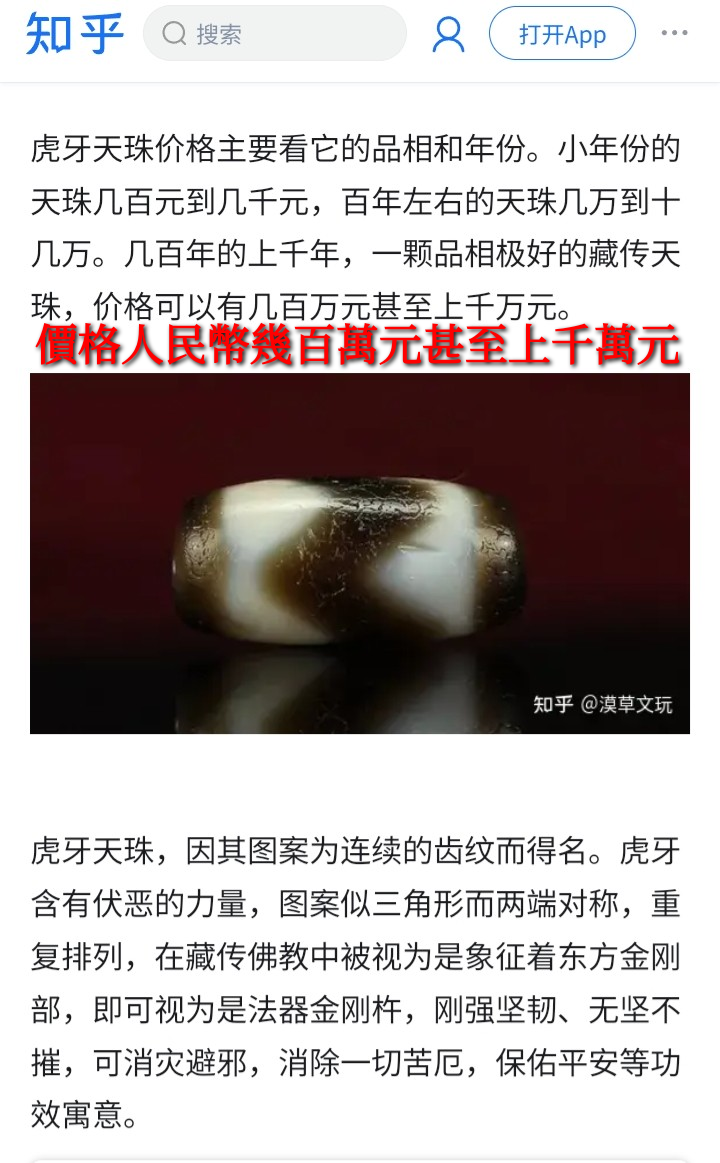
全球已知最古老西藏頂級虎牙老天珠 14 x 14 毫米 The world's oldest known Tibetan top-grade Tiger Tooth old Dzi Bead 14 x 14 mm

全球已知最古老西藏頂級虎牙老天珠 14 x 14 毫米

The world's oldest known Tibetan top-grade Tiger Tooth old Dzi Bead 14 x 14 mm


https://youtu.be/1FIbnq97qlM?si=UauCJiLKNVnmHgdF


https://youtu.be/8uYS8qDWffM?si=obqhru11dNnHOZsB


重量:6 公克 g

尺寸:高 1.4 x 體圓直徑 1.4 厘米 cm


Weight: 6 grams

Dimensions: height 1.4 x body circle diameter 1.4 cm


頂級虎牙老天珠價格達人民幣百萬元以上。虎牙老天珠古樸、自然、渾厚、磨損自然流暢、風化柔和、包漿油潤、黑白分明、咬色清晰、皮殼潤如膏脂、兩端呈現玉質感、中心孔道對穿互接不平整、滿硃砂、表面明顯千年歲月風化紋,珍罕稀有,乃身份象徵。任何一件事物都無法與之媲美。在天珠中,虎牙圖騰具有「伏惡」的寓意,有著可護佑平安的意義。


虎牙老天珠在苯教雍仲時期已出現,比至純老天珠出現的年份還要早上一千年至兩千年,兩三千年前工藝成熟的措思天珠已經存在於富庶階層飾物中。無論是看年份、看品相、或是看圖騰,千年至純虎牙老天珠實屬不可多得男女老少皆宜佩戴的收藏級藏品。連續的齒紋含有「伏惡」的力量,藏傳佛教認為其圖騰象徵東方金剛部,可以降服修持者內心或外在的障礙,有著剛強堅韌、消除波折、勇往直前、移災去邪、保佑平安之意。


物以稀為貴,數量極少是天價老天珠出現的一個主要原因。天價老天珠一般是買不到的,大多都是由私人所收藏著,所以縱使是虎牙老天珠也屬於一處難尋,更別說是頂級虎牙老天珠了!總之頂級虎牙老天珠是一種比鑽石更稀少的世界級存在性稀缺寶石。


The price of top-grade Tiger Tooth Old Dzi Beads reaches over RMB one million yuan. The Tiger Tooth Old Dzi Beads are ancient, natural and thick-round, with natural and smooth wear and tear, soft weathering, oily surface oxidation patina, clear black and white colors, clear boundary line color, smooth skin like grease, jade texture at both ends, central channels that are unevenly interconnected, full of cinnabar, obvious surface weathering patterns over thousands of years, rare and a status symbol. Nothing can compare to it. Among Dzi beads, the tiger tooth totem has the meaning of "subduing evil" and has the meaning of protecting peace.


Tiger tooth old Dzi beads appeared in the Yongzhong (Bonismo) period of Bon Religion, one thousand to two thousand years earlier than the year when pure old Dzi beads appeared. Tsosi Dzi beads with mature craftsmanship two to three thousand years ago already existed in the ornaments of the wealthy class. Whether looking at the year, condition, or totem, the thousand-year-old pure tiger tooth Dzi beads are truly a rare collectible grade collection that can be worn by men, women, and children. The continuous tooth pattern contains the power of "subduing evil". Tibetan Buddhism believes that its totem symbolizes the Eastern Vajra Tribe, which can overcome the inner or external obstacles of the practitioners, and has the power to be strong and tenacious, eliminate setbacks, move forward courageously, remove disasters and evil, and bless the meaning of peace.


Things are valuable because of scarcity, and the extremely small quantity is one of the main reasons for the sky-high price of old Dzi beads. It is generally impossible to buy old Dzi beads that are at sky-high prices, and most of them are collected by private individuals. Therefore, even the old tiget tooth Dzi beads are hard to find, let alone the Top-grade tiger tooth old Dzi beads! In short, the Top-grade tiger tooth old Dzi Bead is a world-class existentially rare gemstone that is rarer than diamonds.


Works of Art


https://youtu.be/6v0qM9_dimc 


Provenance:


Ms. Chen Junying (1932- ). Her father Chen Wancheng was the 20th generation descendant from the ancestor Chen Xiufu [Official name: Guangludafu, an official who was close to the Emperor, and acted according to the edict of the Emperor, also the founding hero of the Ming Dynasty, from Wuhua, Guangdong.], who was nominated as the military Marshal by Ming Emperor Zhu Yuanzhang in Hongwu 18th year (1385 A.D.) Ming Dynasty. She has inherited the family handed-down ancestral collection, including valuable ceramics, jade carved works of art, antiques, bronzes, and Chinese paintings moving from mainland China to Taiwan since Qing dynasty, from her father Chen Wancheng and has been trained to be a good professional collector and an excellent appraiser by family education since childhood for over 80 years.


Chen Xiufu


Official name: Guangludafu, an official who was close to the Emperor, and acted according to the edict of the Emperor, also the founding hero of the Ming Dynasty, from Wuhua county, Guangdong Province, China.


Chen Xiufu was nominated as the military Marshal by Ming Emperor Zhu Yuanzhang in Hongwu 18th year (1385 A.D.) Ming Dynasty.


http://www.nanchens.com/xqxx/xqxx32/xqxx32510.htm 


https://www.xuehua.tw/a/5ec8742f868e1a463e412f06 


https://ppfocus.com/0/cu4cb061d.html 


藝術品


https://youtu.be/6v0qM9_dimc 


來源:


陳俊英女士 ( 1932 - )。她的父親陳萬承是明朝洪武十八年 (公元 1385 年) 被明朝皇帝朱元璋封為軍事大元帥的先祖陳秀甫 (明代開國功臣光祿大夫 [為皇帝近臣依皇帝詔命行事] 陳秀甫 [廣東五華籍]) 的第 20 代後裔。她從父親陳萬承處繼承了家族傳世的祖傳藏品,包括自清朝以來從中國大陸移至台灣的珍貴陶瓷器、玉器、古董、青銅器和中國書畫,她自童年開始透過家庭教育,即被培養成為一位很棒的專業收藏家和優秀的鑑賞家已達 80 多年。


陳秀甫


陳秀甫是明代的開國功臣光祿大夫 [此官名為皇帝近臣依皇帝詔命行事],中國廣東省五華縣人。


明朝洪武十八年 (公元 1385 年) 陳秀甫被明朝皇帝朱元璋封為軍事大元帥。


http://www.nanchens.com/xqxx/xqxx32/xqxx32510.htm 


https://www.xuehua.tw/a/5ec8742f868e1a463e412f06 


https://ppfocus.com/0/cu4cb061d.html